


 Management Consulting
 Software Engineering
 Product & Strategy
 AI
AI Security
 Cloud
Cloud Data
Data Talent


Operationalizing Strategy with a Systems Perspective

While there are many books and much research on organizational development, this system view combined with some validated learning over time is a powerful way to look at organizational challenges as a coach/consultant.
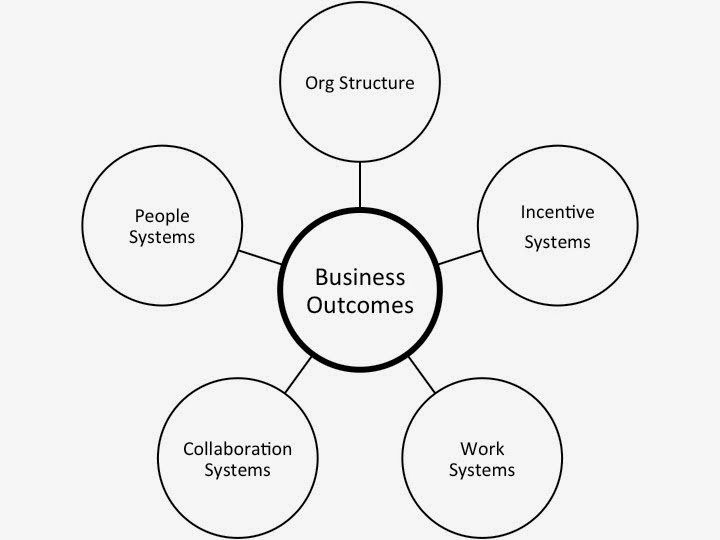
Let’s take a closer look to define these areas then apply some validated learning from my own experience.
Business Outcomes – the outcomes desired from the business strategy selected
Org Structure – the structure of power and authority to facilitate decision making
Incentive Systems – rewards for individual and group performance
Work Systems – how people get work done in the organization
Collaboration Systems – systems to overcome the friction to collaboration introduced by the org structure
People Systems – hiring, firing, development, HR systems – both tactical and strategic
Validated Learning (observations and experiences over time)
- Business outcomes are required to think about the other dimensions; and interestingly, in my experience even some top leaders can struggle to articulate these, so it may require some elicitation and dialogue. I like to use the pithy term “operationalize strategy” when discussing this topic.
- Incentive systems usually mirror org structure fairly closely.
- The org structure will help determine both work systems and collaboration systems; however, collaboration systems have a stronger relationship because they must overcome the friction introduced by the structure itself.
- Incentive systems and people systems strongly impact everything else except strategy.
- People tend to focus first on org structure and work systems because they are the most visible, tangible, and even “fun” to work with.
- Each organization design decision made will impact the other dimensions so as the design is created, the entire system must be reevaluated.
- Organizations are typically good at people systems when it comes to tactical training and development, but more powerful levers are hiring, firing, and strategic training needs.
- The most common constraint on change involves incentive systems.
What observations and experiences do you have using a systems perspective to view organizational challenges? Has the use of a systems perspective helped overcome these challenges? Leave your comment below so that we can get the conversation started.
Comment (1)
Peter Roth
Thanks for the great article about System thinking in business. That’s really consistent. If you have some more articles related to Agile in Software Outsourcing Development, that’s great!
Have a nice weekend.