Management Consulting
 Software Engineering
 Product & Strategy
 AI
 Security
 Cloud
 Data
 Talent


Encapsulated Technology
Real edges: code somebody owns, interfaces that hide the inside, dependencies managed at the boundary.
The Test Can one team change one capability without asking permission of another?

Move beyond isolated AI experiments to build scalable, domain-driven systems with AI-ready architectures.
Enhance valuation and accelerate ROI through due diligence, tech migrations, and strategic restructuring.
Control cloud costs, streamline data, and focus investments on high-value, scalable solutions.
Streamline operations and improve decision-making by aligning your ERP systems with how your business actually works.
Reduce risk and increase resilience by closing the security gaps hiding in your architecture and workflows.
Optimize operations, restructure teams, and modernize technology to maximize the value of digital investments.
Deliver mission-critical software in production-ready increments that create measurable value early.
Reduce risk and complexity with every cycle, turning legacy systems into platforms that can evolve.
The belief that shaped us — and how it evolved into LiminalArc, the natural next step in our journey.
Our team of over 100 experts spans the nation, from consultants and technical architects to product specialists.
We are looking to hire mature, pragmatic consultants who are deeply passionate about meaningful change.


Most AI work stalls because the conditions it needs were never created: encapsulated technology, clean data, real ownership, and governed intent. We create those conditions inside one slice of your business, take it to production, and measure what it returned.
Start With a ConversationEvery pilot works until it touches production, where your real conditions live. The shared codebase nobody owns, the data with three conflicting definitions of customer, the process with eleven handoffs. Then it dies. Nothing changed but the environment. The demo told the truth. It showed you what's capable with AI when the right conditions exist, and what it can't do when they don't.
One team runs a contained experiment, and builds the conditions it needs to succeed.
The difference in pilot and production is your readiness gap. The pilot exposed it. Now you have to close it.
Multiple teams take it on, and it meets outside dependencies and unknown variables.
AI adds $18,000 a year to every developer, on top of a salary that was already climbing. Where's the ROI? That's the question everyone's asking.
Nobody is governing either end of the pipe. At the front, work enters the queue on a mandate, not on a return weighed against the time, attention, and tokens it will consume.
At the back, the next tranche is funded based on slides, not a realized outcome. Released capacity, redeployed capacity, retired defects, faster releases: if you're not measuring value in these terms, the benefit lives only on paper, and not in reality.
Build a workforce around AI-accelerated engineering without measuring what it returns and you have permanently raised your cost base, which is far harder to unwind than it was to create. Agentic governance is how both ends get closed.
You can't automate a tangle, only a clean boundary. Most of the industry solves for AI readiness with a maturity model: five levels, a spider chart, and an eighteen-month program to reach level three. We use four conditions, each a different way of drawing that boundary.
Real edges: code somebody owns, interfaces that hide the inside, dependencies managed at the boundary.
The Test Can one team change one capability without asking permission of another?
Data validated, owned, and documented where the team creates it, not repaired downstream in a warehouse.
The Test Do you know where a critical data element is created, and that it's valid there?
Teams aligned to business capabilities. Technology aligned to domains, not components.
The Test For a capability that matters, is there one team that owns it?
One place where an AI hypothesis gets funded, measured, scaled, or killed.
The Test Does a system move a winning pilot to production, and kill a failing one?
An application is basically just a package. It's whatever a vendor roadmap, an acquisition, or a decade in one codebase happened to bundle. Live capabilities beside dead ones, your differentiating logic beside commodity you could buy tomorrow. You can't encapsulate that, and you can't assign it an owner. Stop modernizing applications. Start liberating capabilities.
Beta This model is still under development.
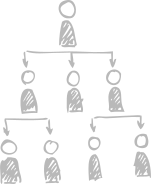
Business units own their AI strategy and run experiments close to the work. A run layer owns what gets proven and resolves the many-to-many between units and capabilities. A capability layer, already in place, stays a tree. The line between them is where trust is either earned or lost.
The whole model is drawn out on its own page, layer by layer, at a size you can read.
Explore the MethodologyThe key to unlocking the value of AI is instantiating the conditions in production that made the pilot successful.
Free the capability. Cut it at its seam, clean its data at the source, give one team ownership.
Put tools on a boundary with edges, where an agent can be constrained and its work checked.
Act on business objects that are finally clean and addressable. This is where revenue and margin live.
Most organizations run it backwards: buy the tool, re-engineer the process, and extract last, if ever. Same work, wrong order, and it is not a methodology preference. It is the order the dependencies run in. Your existing investment is not wasted. It is waiting on the extract step.
Horizontal rollouts move everything and finish nothing. Go vertical instead. Not one practice everywhere, but everything in one place.
A real one, with money attached, instead of a use case hunting for a justification.
The capability that owns that problem, cut at its natural seam: organization, application, data.
All four conditions, in production, in one bounded place.
Map the technology, then supervise the build inside the boundary, with humans defining what done means.
In production, in numbers your CFO accepts, in about ninety days.
Value compounds in slice two building on the work we did in slice one.
Each slice is one capability in one part of the business, not a program that touches every team. We staff the people who do the work, so the load lands on us and not on a leader already covering two roles. The ninety-day proof means nobody commits capacity on faith.
The pattern is the strangler fig, growing around the tree, capability by capability, until the old tree is structure rather than function. The work ends once the next slice no longer provides a meaningful ROI.
We've been doing enterprise transformation with static playbooks and no AI at all for sixteen years. The last six years have been spent focusing on extracting capabilities out of legacy technology and modernizing it by hand, one document at a time. Which means we know exactly what needs to be agentified, exactly what context it requires, and exactly what happens when that context isn't there.
LeadingAgile is our history.
LiminalArc is that same practice, agentified.
Today, general AI has read everything public but knows nothing about you, your stack, your history, or the reasons behind the reasons. Building that context layer is the next frontier in enterprise AI, so now we're focused on compressing months of archaeology into weeks.
What AI will never replace is human judgment. Taste, discernment, and the call that weighs a decision against twenty years of experience guided by intuition. The execution moves to machine speed. The judgment stays where it always was.
This technology is genuinely new and we're figuring it out alongside everyone else. We're just doing it from sixteen years of reps instead of from a standing start.
Learn More About UsThe first step is a conversation to find out who owns what, where the pain and the value line up, and what success looks like in terms of business value delivered. Every stage after that is a gate, and you keep everything of value after each stage: the map, the frame, the backlog, and the proof.
Get in TouchExplore our latest white papers, articles, videos, and resources on transformation, technology, and business strategy.