

 Management Consulting
 Software Engineering
 Product & Strategy
 AI
AI Security
 Cloud
Cloud Data
Data Talent


Putting the Enterprise Back in Enterprise Architecture w/ Ross Beurmann

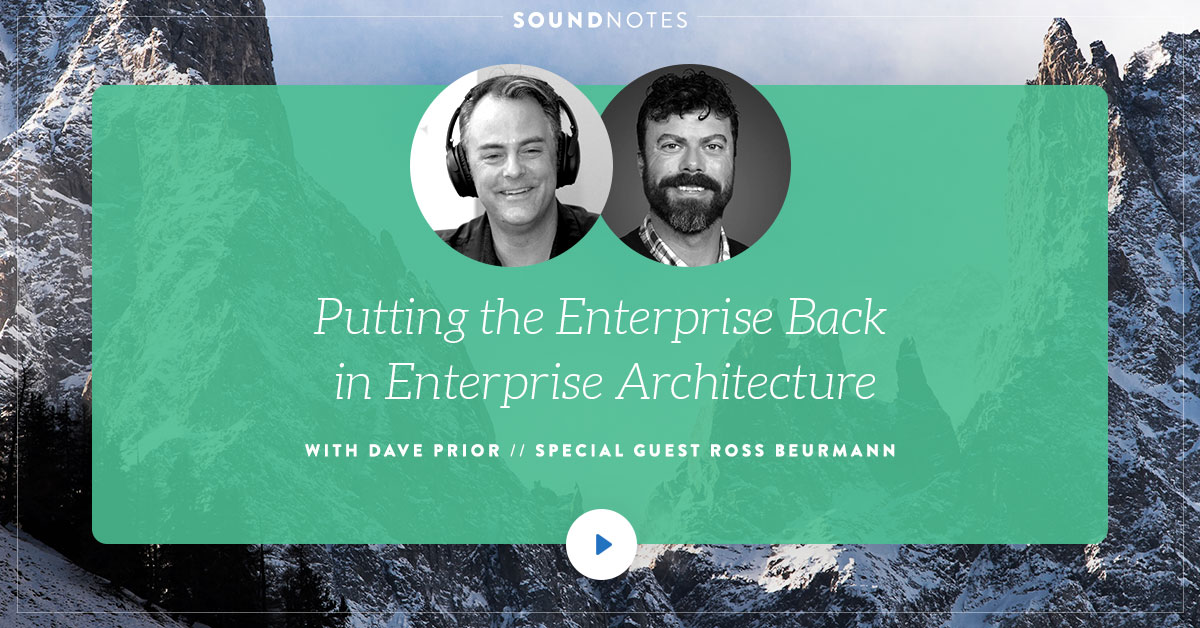


Listen to the SoundNotes Podcast on the go!
Find and subscribe to SoundNotes on:
Despite the fact that in many organizations the Enterprise Architect and the Enterprise Solutions Architect are often conflated, they are very distinct roles that require different skill sets and areas of expertise.
The Enterprise Solutions Architect is a role that focuses on designing solutions to problems that tend to be IT-centric, while an Enterprise Architect focuses more on designing or documenting the relationship between all the systems across the Enterprise and how they interact to deliver value.
In this episode of LeadingAgile’s SoundNotes, Ross Beurmann is back to bring some clarity to the difference between the two roles, the nature of the work, and the differences in the skill sets required for each role.
Zachman Framework
During the interview, Ross references the Zachman Framework, which was developed by John Zachman in the 1980’s. The framework “provides a formal and structured way of viewing and defining an enterprise” (see Wikipedia link below). If you’d like to read up on it, here are some places to get started:
- Zachman Framework in Wikipedia
https://en.wikipedia.org/wiki/Zachman_Framework - The Concise Definition of The Zachman Framework by: John A. Zachman
https://zachman.com/about-the-zachman-framework
Contacting Ross
- Web: https://liminalarc.co/guides/ross-beurmann/
- LinkedIn: https://www.linkedin.com/in/rossbeurmannzcea/
- Email: Ross.Beurmann@leadingagile.com
Contacting Dave
- Email: dave.prior@leadingagile.com
- LeadingAgile: https://liminalarc.co/guides/dave-prior/
- LinkedIn: https://www.linkedin.com/in/mrsungo/
- Twitter: http://twitter.com/mrsungo
- Personal blog: http://drunkenpm.net
We Need Reviews
If you like this podcast, we’d be very grateful for reviews or feedback in iTunes. It will help us create more visibility for this podcast so that we can reach more people. Click here to leave us a review or post feedback.
Feedback/Questions
If you have comments on the podcast or have questions for the LeadingAgile coaches that you’d like to have addressed in a future episode of LeadingAgile’s SoundNotes, you can reach Dave at dave.prior@leadingagile.com
LeadingAgile CSM and CSPO Classes
For information on LeadingAgile’s upcoming public CSM and CSPO classes, please go to: https://liminalarc.co/our-gear/training/
Use the discount code: LA_Podcast to receive a 15% discount on the class.