Management Consulting
 Software Engineering
 Product & Strategy
 AI
 Security
 Cloud
 Data
 Talent


Why Labor Gets Cut First as AI-Spend Rises


When AI usage costs show up, they tend to land in IT’s operating budget, and when that budget is fixed, headcount is usually what gives. AI tokens are an operating expense rather than part of a capitalized software asset, SaaS commitments are hard to reduce, and labor is the one line a leader can change quickly.
The deeper problem is cost myopia. Cost is easy to see and control, while the value an investment produces is further out, and many companies can’t connect the money they spend to the results it creates. For CIOs, CFOs and anyone running a fixed IT budget, the best protection is to understand the value your budget generates before someone else decides what to cut.
Video Transcript
Stacy Gordon
Why does that AI usage bill always seem to end up on headcount?
Len Greski
Labor’s the easiest thing to cut.
It’s easier to control your costs rather than benefits or more specifically revenue. Cost is right in front of you, whereas value is further out.
Many companies struggle to establish cause and effect between the investments they make and the value they expect to realize from them.
Stacy Gordon
Reports that are out there today saying AI is eliminating jobs, but I believe you don’t think that’s the right story. What is the right one?
Len Greski
Well, the right story, and it’s been this way for decades related to AI, is about value.
And now AI is so much more accessible that people are focusing on how do you free up costs to experiment with it versus looking at what are we actually going to do and how does what we’re going to do generate value?
Stacy Gordon
And so why does that AI usage bill always seem to end up on headcount?
Len Greski
Well, because if you think about what happens in a company with various cost structures, there’s a big distinction between capital expenditures and operating expenses. AI enabled development introduces new categories of spend like the dreaded AI tokens. And those categories of spend are inherently operational because they’re not baked in to the newly created software asset.
So companies typically centralize these operational costs in IT because if it looks like IT and it smells like IT, IT’s going to get the expenses. And IT may or may not allocate those expenses out to business units based on some form of rationalization, whether it’s number of employees or number of servers that are used by business unit.
And if the costs aren’t allocated to a business unit, then the IT department gets stuck with them and then it’s got to figure out where else to cut to meet the annual budget commitments. And so if in IT, the labor is neither unionized nor protected by some fixed bid contract, labor’s the easiest thing to cut.
Stacy Gordon
I loved your term cost myopia.
Len Greski
Myopia is a vision problem where the visual images come to a focus in front of the retina and that results in poor vision of distant objects. And a secondary definition is a lack of foresight or discernment or a narrow view of something.
And cost is right in front of you, whereas value is further out. And so myopia is a good way to metaphor for the focus on cost rather than value.
And leaders focus on cost rather than value for two reasons. Number one, it’s easier to control your costs rather than benefits or more specifically revenue. And second is that many companies struggle to establish cause and effect between the investments they make and the value they expect to realize from them.
Stacy Gordon
And is that why you would say labor’s kind of always the relief valve? It’s the easier one to understand?
Len Greski
That’s right because typically a department is going to, a budget is broken out into different categories of expense. It’s easier to change OpEx than CapEx because once you’ve capitalized something, you’re stuck with its amortization schedule.
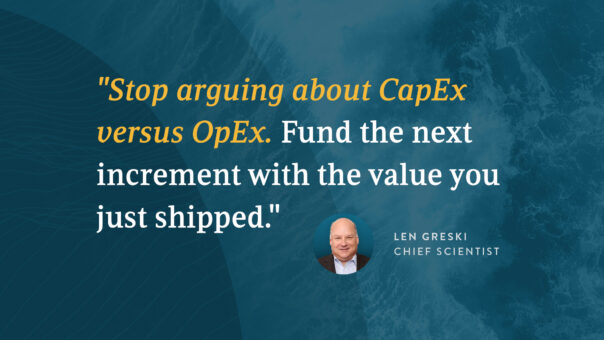
With the rise of software as a service and cloud computing, those categories of expenses have moved from CapEx to OpEx. And so if you’ve got a commitment of 10 million a year in spend to your SaaS vendor, it’s really hard to reduce that.
And so then labor becomes the relief valve.
Stacy Gordon
It’s got to be frustrating. When you get handed an operating budget that you didn’t get to set and you’ve got to make tough decisions within that, that’s a struggle for anyone.
Len Greski
Well, it is, but it’s also a reality of a business that we all have to face into is the budget is a fixed thing, and that’s why it’s so important to be able to understand the value that’s generated by your budget.