

 Management Consulting
 Software Engineering
 Product & Strategy
 AI
AI Security
 Cloud
Cloud Data
Data Talent


Creating Empathy Maps with Scott Sehlhorst

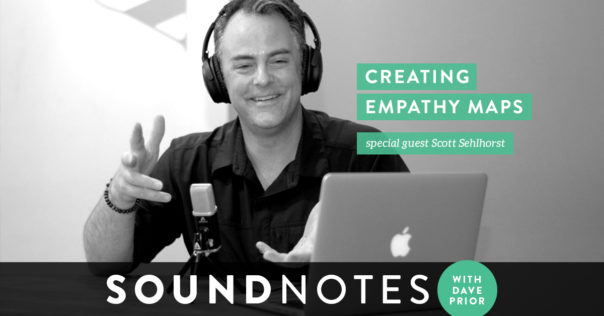
In October, LeadingAgile SVP, Scott Sehlhorst spent some time talking with Dave about the importance of Personas and Proto-Personas and how to use them. In this episode of SoundNotes, Scott is back to talk about Empathy Maps, how they work, why they are so valuable and how to create one. During the conversation, Scott and Dave talk through each step of creating an Empathy Map. The podcast is one of our longer ones, but if you are seeking a better understanding of how to put one together, you’ll find a lot of valuable information in this interview.
You’ll probably want to download a copy of David Gray’s Empathy Map to have on hand while you listen to this episode. You can find that here: http://gamestorming.com/empathy-mapping/
SHOW NOTES
- 00:08 Interview Begins
- 00:50 Some background on Scott
- 02:30 Intro to the topic of Empathy Maps and how they relate to Proto-Personas and Personas
- 03:09 What is Empathy? How does it relate to Sympathy and Cognitive Empathy
- 05:46 What is an Empathy Map and who creates it?
- 08:42 Understanding their understanding of their problem
- 09:39 Whose job is it to create it?
- 10:45 Where to learn how to interview users
- 11:30 How do you pick which customers to focus on? (And the set up for the example we walk through)
- 20:20 Who are we empathizing with? (Understanding the role you are focusing on)
- 21:17 Understanding what they need to do
- 24:13 What is the goal they are trying to achieve?
- 26:25 Understanding what success means for the person we are focusing on
- 27:54 What they see and what do they say – situational awareness and how they interpret what they see
- 30:08 The disconnect between what do I see and what do I say
- 32:16 What do they do
- 33:19 The Double Design Process (Double Diamond Design)
- 36:18 Moving from empathy maps to experiment maps or the value proposition canvas
- 37:28 What do they hear (and how it is not all about sound)
- 41:18 What do they think and feel
- 45:45 How often do I revise the empathy map
- 48:35 When I’m done filling out the empathy map, what do I do with it?
- 51:05 How to reach Scott with additional questions about Empathy Maps
- 51:57 Podcast Ends
LINKS FROM THE PODCAST
- LeadingAgile SoundNotes: Using Personas to Reduce Risk w/ Scott Sehlhorst (our earlier podcast on personas)
http://bit.ly/2BGumyJ - David Gray’s Updated Empathy Map
http://gamestorming.com/empathy-mapping/ - “Mental Models” – Indi Young
http://amzn.to/2BGBtaw - “Interviewing Users: How to Uncover Compelling Insights” – Steve Portigal
http://amzn.to/2zTzQWl - “Impact Mapping: Making a big impact with software products and projects” – Gojko Adzic
http://amzn.to/2k4cKpA - Double Design – The Double Diamond Design Process
http://bit.ly/2B9EwvF
CONTACTING SCOTT
If you’d like to contact Scott you can reach him at:
- LeadingAgile: https://liminalarc.co/guides/scott-sehlhorst/
- Twitter https://twitter.com/sehlhorst
- LinkedIn: https://www.linkedin.com/in/sehlhorst/
- Blog: http://tynerblain.com/blog/
CONTACTING DAVE
If you’d like to contact Dave you can reach him at:
- LeadingAgile: https://liminalarc.co/guides/dave-prior/
- LinkedIn: https://www.linkedin.com/in/mrsungo
- Twitter: https://twitter.com/mrsungo
- Email: dave.prior@leadingagile.com
SEND US YOUR QUESTIONS
If you have a question you’d like to submit for an upcoming podcast, please send them to dave.prior@leadingagile.com
UPCOMING CLASSES
And if you are interested in taking one of our upcoming Certified Scrum Master or Certified Scrum Product Owner classes, you can find all the details at https://liminalarc.co/our-gear/training/